Cart
0
How to Tell if a Moroccan Rug Is Real
Cheap synthetic rugs printed with Berber-style patterns flood the market, and most buyers can't tell the difference until the pile flattens after six months. A genuine Moroccan rug carries physical traits a machine-made copy cannot replicate — irregular knotting, natural wool texture, and a construction process that takes weeks, not minutes. Knowing what to check before purchase saves money and protects against a purchase that looks right in a photo and falls apart in a living room.
Check the Material First
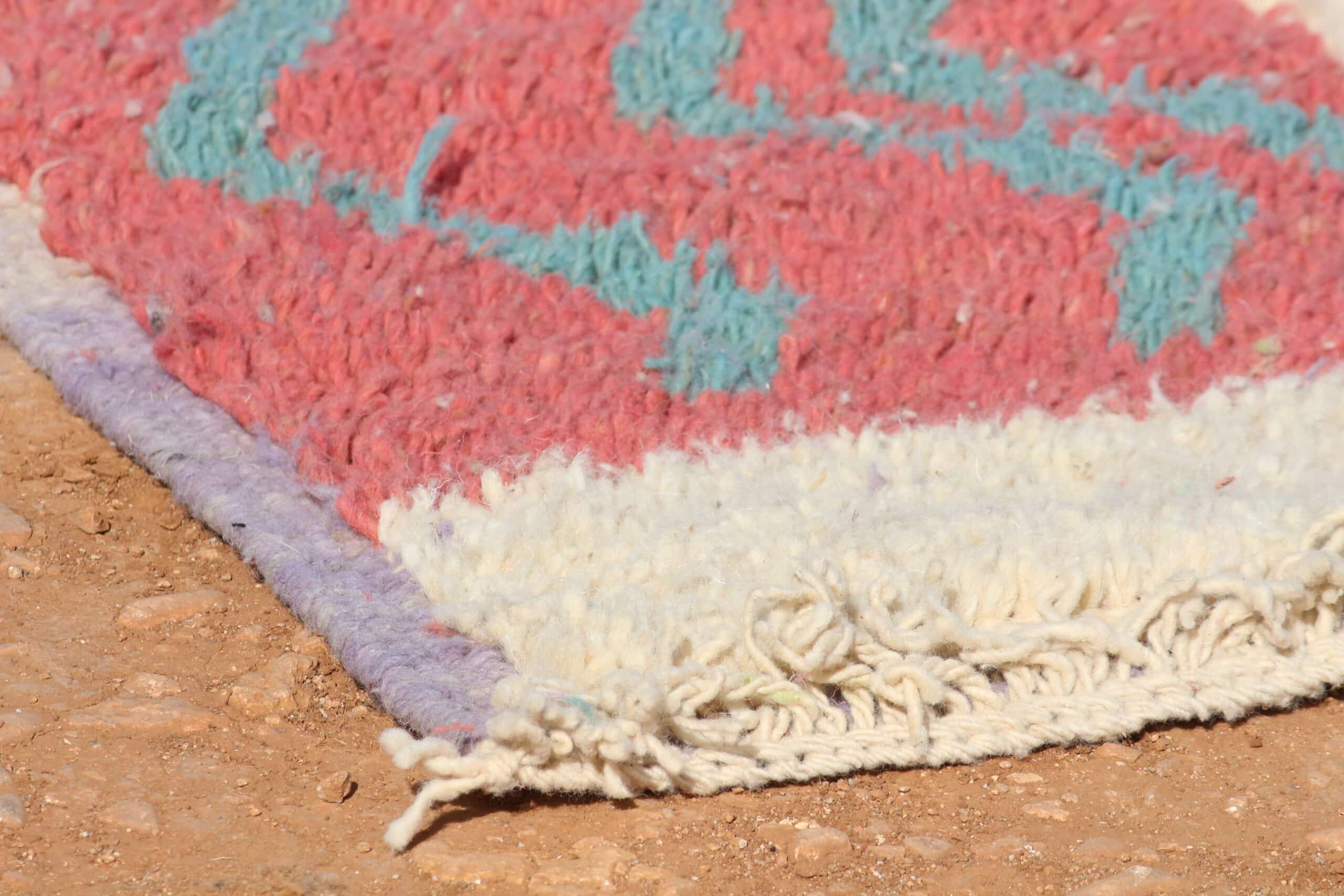
Authentic Moroccan rugs use hand-spun sheep's wool, sometimes blended with goat hair for structural pieces like kilims. Wool has a natural sheen that varies slightly across the rug, along with a faint lanolin smell when the fibers are new. Synthetic rugs use polypropylene or acrylic, which look uniformly glossy under light and feel slick rather than fibrous. Rub a few strands between your fingers — wool has texture and slight resistance; synthetic fiber feels smooth and slippery, almost like plastic thread.
A burn test settles doubt for buyers willing to snip a hidden thread. Wool singes and smells like burning hair, then leaves a crumbly ash. Synthetic fiber melts into a hard bead and smells like burning plastic.
Look for Irregularities in the Pattern
Machine-made rugs print patterns with perfect symmetry, repeated identically across the entire surface. Hand-woven Moroccan rugs never achieve that precision, and that's the point. Berber weavers work from memory and improvisation rather than a fixed template, so lines shift slightly, motifs vary in size from one section to the next, and borders rarely align with mathematical exactness. A rug with flawless, mirror-image symmetry from corner to corner signals machine production, not tribal handwork.
Examine the Knots on the Back
Flip the rug over. Hand-knotted construction shows individual knots tied one at a time, visible as small, slightly uneven bumps across the back surface. Knot density varies by region and rug type, but the irregularity itself is the authenticity marker — no two knots sit at identical spacing. Machine-made or tufted rugs show a uniform grid pattern on the back, often backed with a glued fabric layer to hold the pile in place. That glued backing is one of the clearest fakes; a genuine hand-knotted rug has no adhesive layer at all.
Fringe Tells a Story Too
Fringe on an authentic rug forms a natural extension of the foundation warp threads — the same fibers that run through the entire rug structure. Pull gently on a fringe strand and it connects directly to the weave. Fake rugs often glue or sew fringe onto the edge as a separate piece, disconnected from the rug's internal structure. A fringe that comes loose easily or looks sewn-on rather than woven-through is a red flag.
Weight and Feel Matter
Wool holds natural weight. Pick up a section of the rug and authentic Moroccan wool feels substantial, with a slight give when pressed. Synthetic fiber rugs feel lighter and springier, bouncing back too quickly under pressure. Vintage wool, in particular, develops a soft, broken-in density over decades that synthetic material never replicates, regardless of how it's manufactured.
Ask About Origin and Documentation
A legitimate seller can name the tribe or region — Beni Ourain, Boujaad, Azilal, Taznakht — and explain sourcing. Vague answers, stock photos reused across multiple listings, or prices far below market range for the claimed size and wool type all point toward a mass-produced imitation. Genuine tribal rugs carry natural price variation tied to labor time, wool quality, and rug size, so an unusually low price on a "hand-knotted" listing deserves scrutiny.
Browse our authenticated Beni Ourain collection to see verified hand-knotted construction firsthand, or explore Boujaad rugs sourced directly from Rehamna weavers.
For further reading on traditional Berber weaving techniques, the Victoria and Albert Museum's textile archive documents regional methods and material history.
Frequently Asked Questions
How can I tell if a Moroccan rug is handmade?
Check the back for irregular, individually tied knots rather than a uniform machine grid, and look for slight pattern variation across the rug's surface.
Do authentic Moroccan rugs have a smell?
Yes — natural wool carries a faint lanolin scent, especially when new, which synthetic fiber rugs lack entirely.
Why are some Moroccan rugs so cheap?
Low prices often signal synthetic material or machine production rather than hand-knotted wool, since authentic weaving takes weeks of skilled labor.
Is a Berber-style rug the same as a real Berber rug?
No — "Berber-style" often describes a printed pattern on synthetic fiber, while a real Berber rug is hand-knotted by tribal weavers using natural wool.
Can vintage Moroccan rugs be verified as authentic?
Yes — vintage pieces show wear consistent with natural wool aging, irregular knotting, and fringe woven directly into the foundation, all of which are hard to fake convincingly.